
Best Countertop Materials for Restaurants
Your restaurant countertops take a beating every single day. Hot pans, sharp knives, spilled sauces, constant wiping. The wrong material will stain, chip, or fall apart within a year or two. The right one will hold up for a decade or more with basic care.
This guide breaks down the most common commercial countertop materials used in restaurants across Saskatchewan and beyond. We cover durability, food safety, maintenance, and cost so you can pick the right surface for your kitchen, bar, or front counter.
If you want help choosing the right countertop for your restaurant project, request a free quote or call us at (306) 975-2020.
What makes a restaurant countertop different from a home countertop?
Home kitchens and restaurant kitchens are not the same. A home countertop might see an hour of use per day. A restaurant countertop sees 10 to 16 hours of constant use. That changes everything about which materials work and which ones fail.
Restaurant countertops need to meet a few basic requirements that home countertops do not. They need to be food-safe, meaning no porous surfaces where bacteria can hide. They need to handle heat from pots, pans, and hot plates without scorching or cracking. They need to resist stains from grease, wine, tomato sauce, and cleaning chemicals. And they need to be easy to sanitize multiple times per day.
Health inspectors look at your countertop surfaces during every visit. A cracked or damaged surface can lead to a failed inspection. That is not just an inconvenience. It can shut down your kitchen until the problem is fixed.
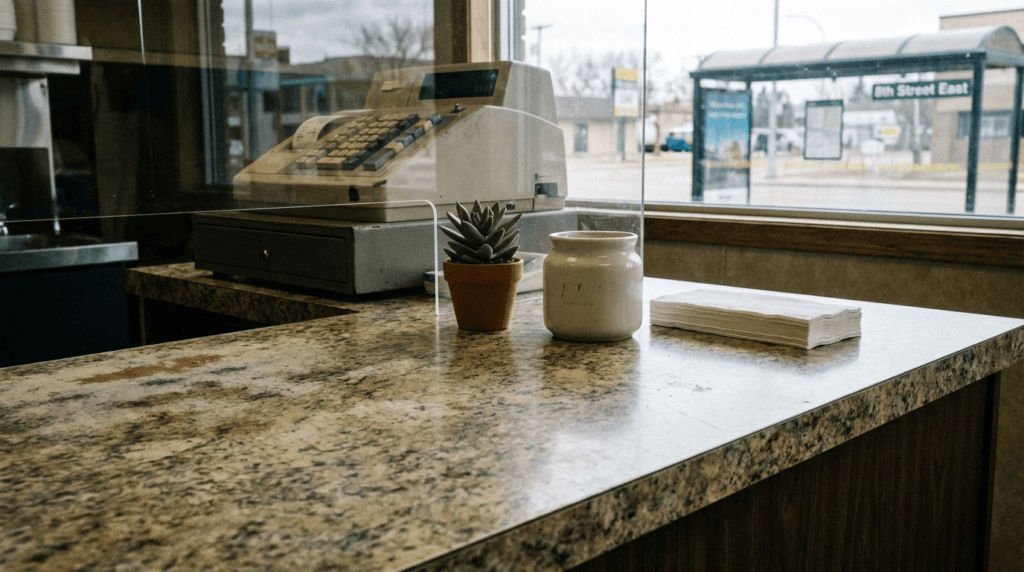
Laminate countertops for restaurants
Laminate is the most budget-friendly option for restaurant countertops. It is made from layers of paper or fabric bonded together with resin and pressed onto a particleboard or MDF core. Modern commercial-grade laminate has come a long way from the flimsy stuff you might remember from the 1990s.
Where laminate works well
Laminate is a good fit for front-of-house counters, cashier stations, and server prep areas where the surface does not take direct heat from cooking. It works for buffet stations and drink bars where the main concern is spills rather than hot pans.
Durability
Commercial-grade laminate (like Wilsonart or Formica’s commercial lines) handles daily wiping, light impacts, and most stains without trouble. It resists moisture on the surface, though the seams and edges are the weak points. Water that seeps into seams can cause swelling in the core material over time.
Laminate does not handle heat well. A hot pan placed directly on the surface will leave a permanent mark. It also scratches more easily than solid surface or quartz, which means knife marks can build up over months of use.
Cost
Laminate runs about $25 to $50 per square foot installed, making it the lowest-cost option on this list. For a restaurant owner on a tight budget, it can be a smart choice for areas that do not see heavy kitchen abuse.
Maintenance
Wipe down with a damp cloth and mild cleaner. Avoid abrasive scrubbers that can dull the surface. Most commercial cleaning products are safe to use on laminate, which makes end-of-night cleaning simple.
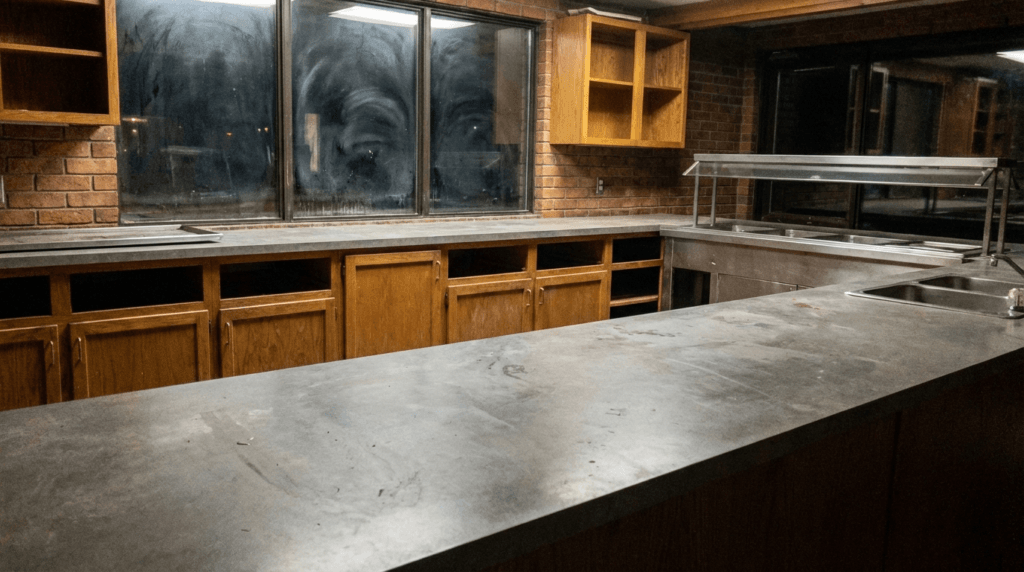
Solid surface countertops for restaurants
Solid surface countertops (brands like Corian, LG Hi-Macs, and Staron) are made from a blend of acrylic or polyester resins mixed with natural minerals. The result is a non-porous surface that can be shaped, joined, and repaired in ways other materials cannot.
Where solid surface works well
Solid surface is one of the most popular choices for restaurant countertops because it checks almost every box. It works in back-of-house prep areas, front counters, bar tops, and serving stations. The seamless look is especially good for health code compliance because there are no joints or cracks where food particles can collect.
Durability
Solid surface handles daily restaurant use well. It resists stains, does not absorb liquids, and holds up to constant cleaning with commercial sanitizers. Minor scratches and scuffs can be buffed out with fine sandpaper, which means the surface can be renewed without replacing it.
The main weakness is heat. Solid surface can handle warm dishes, but a pan straight off the burner will leave a mark. Most restaurants solve this with trivets or heat pads in kitchen prep areas.
Cost
Solid surface runs about $50 to $100 per square foot installed. It costs more than laminate but less than quartz. The ability to repair scratches and burns adds value over the long term because you avoid full replacement costs.
Maintenance
Daily cleaning with soap and water or a commercial kitchen sanitizer is all you need. For tougher stains, a mild abrasive cleaner works without damaging the surface. Every few years, a professional can sand and refinish the entire countertop to make it look new again.
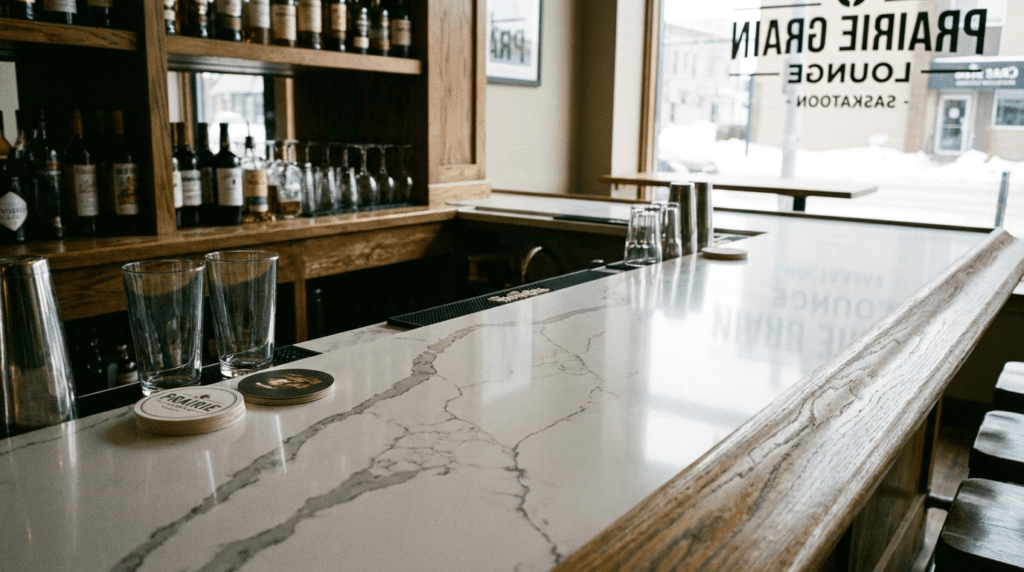
Quartz countertops for restaurants
Engineered quartz (brands like Caesarstone, Cambria, and Silestone) is made from roughly 90% ground natural quartz mixed with resins and pigments. It is one of the hardest and most durable countertop materials available for commercial kitchens.
Where quartz works well
Quartz is a strong choice for high-traffic restaurant areas. It works well for kitchen prep counters, bar tops, pastry stations, and any surface that sees constant use. Many restaurant and hospitality projects use quartz in both the kitchen and the front of house because it handles everything thrown at it.
Durability
Quartz is extremely hard and scratch-resistant. It does not chip easily, does not stain from food or drinks, and does not need sealing. The non-porous surface makes it easy to sanitize and keeps it compliant with health codes.
Like solid surface, quartz has a heat limit. Extreme heat (above about 150 degrees Celsius) can damage the resin binders. Hot pads are still a good idea for pots and pans coming directly off the stove. Unlike solid surface, quartz cannot be sanded and refinished if it does get damaged.
Cost
Quartz runs about $80 to $150 per square foot installed. It is the most expensive option on this list, but it also lasts the longest with the least maintenance. For a restaurant that plans to stay in the same location for 10 or more years, quartz often pays for itself.
Maintenance
Wipe with soap and water or any non-abrasive commercial cleaner. Quartz does not need sealing, polishing, or refinishing. It is about as low-maintenance as a countertop surface gets.
How to choose the right countertop for your restaurant
The best material depends on where the countertop goes and how it will be used. Most restaurants end up using more than one material in different areas.
Here is a quick breakdown by restaurant area:
Bar tops and serving counters: Quartz or solid surface are both strong choices. Quartz offers better scratch resistance. Solid surface offers seamless joints and easy repair.
Front counter and cashier area: Laminate or solid surface work well here since these areas see less abuse than the kitchen. Solid surface gives a more polished look. Laminate saves money.
Pastry and baking stations: Quartz is excellent for pastry work because it stays cool and provides a smooth, hard surface for rolling dough.
If you are planning a restaurant build-out or renovation, the countertop material is one of the decisions worth getting right the first time. Replacing countertops in a working restaurant is expensive and disruptive. Starting with the right material avoids that problem.
Countertop material comparison at a glance
| Feature | Laminate | Solid Surface | Quartz |
|---|---|---|---|
| Heat resistance | Low | Moderate | Moderate |
| Scratch resistance | Low | Moderate | High |
| Stain resistance | Moderate | High | High |
| Food safety | Good (watch seams) | Excellent | Excellent |
| Repairability | Low | High | Low |
| Cost per sq ft | $25-$50 | $50-$100 | $80-$150 |
| Lifespan | 5-10 years | 10-15 years | 15-25 years |
Frequently asked questions
Can you use laminate countertops in a commercial kitchen?
Laminate works for front-of-house areas, cashier stations, and serving counters. It is not the best choice for back-of-house cooking areas because it cannot handle direct heat and scratches more easily than other materials.
How often do restaurant countertops need to be replaced?
It depends on the material. Laminate countertops in a busy restaurant may need replacing every 5 to 10 years. Solid surface can last 10 to 15 years with periodic refinishing. Quartz can last 15 to 25 years or more with proper care.
Are solid surface countertops food-safe?
Yes. Solid surface is non-porous, which means bacteria and food particles cannot penetrate the surface. The seamless installation (no joints or seams) makes it especially easy to sanitize and keep compliant with health codes.
What countertop material is best for a restaurant bar?
Quartz and solid surface are both popular choices for restaurant bars. Quartz handles spills, glass impacts, and daily wear without showing damage. Solid surface allows for seamless designs with integrated features. Both are easy to clean and look professional.
Get help choosing the right countertop for your restaurant
Broadway Millwork has been building commercial countertops for Saskatchewan restaurants for over 30 years. We work with laminate, solid surface, quartz, and other commercial-grade materials to match the right surface to your kitchen, bar, or dining area.
We handle everything from material selection to professional installation, so you get countertops that are built to last in a working restaurant.
Request your free countertop quote or call (306) 975-2020 to talk with our team. We are available Monday to Friday, 7 a.m. to 6 p.m.
Request a Quote
Service Areas
We serve businesses across Saskatchewan, from Saskatoon and Regina to smaller regional centres throughout the province. Here are some of the communities where we regularly complete commercial millwork projects:
- Saskatoon
- Regina
- Prince Albert
- Moose Jaw
- Swift Current
- Yorkton
- North Battleford
- Lloydminster
- Estevan
- Weyburn
- Martensville
- Warman
- Humboldt
- Meadow Lake
Don’t see your community on the list? We take on projects across Saskatchewan and into neighbouring provinces, including Alberta and Manitoba. Contact us to discuss your project location and we’ll let you know how we can help.