
Low-VOC Cabinet Finishes: Health and Environmental Benefits
If you have ever walked into a freshly renovated office and been hit by a strong chemical smell, you have experienced VOCs firsthand. That smell is not just unpleasant. It can cause headaches, dizziness, and breathing problems for the people who work in that space every day. Low VOC cabinet finishes are the simplest way to avoid this problem in your next commercial project.
Whether you are renovating a medical clinic, a school, or an office building, the finish on your cabinets affects indoor air quality for years after installation. Traditional solvent-based finishes release chemical fumes long after the paint dries. Low-VOC alternatives cut those emissions down to a fraction of what conventional products produce.
This guide explains what VOCs are, why they matter in commercial spaces, and how to choose the right low-VOC finish for your project. If you want help picking the best finish for your commercial cabinets, request a free quote or call us at (306) 975-2020.
What are VOCs and why do they matter?
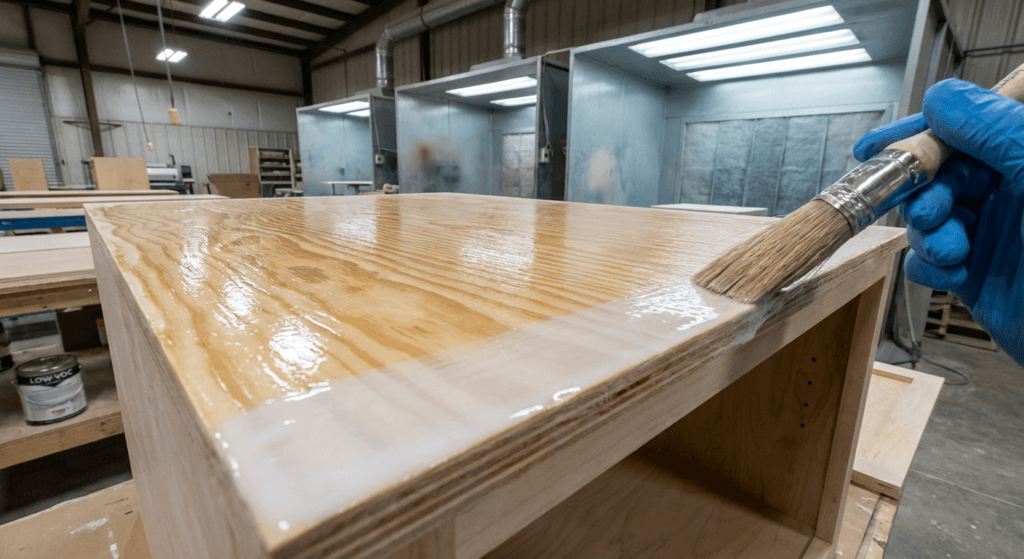
VOC stands for volatile organic compound. These are chemicals found in paints, stains, lacquers, and adhesives that evaporate into the air at room temperature. When cabinet finishes dry and cure, they release these compounds into the surrounding space. This process is called off-gassing, and it can continue for weeks or even months after application.
In a home, off-gassing from a small bathroom vanity might go unnoticed. In a commercial building with dozens or hundreds of cabinets, the effect adds up fast. Research shows that indoor VOC concentrations can be up to seven times higher than outdoor levels, especially in newly renovated spaces with poor ventilation.
Common VOCs found in traditional cabinet finishes include formaldehyde, toluene, xylene, and benzene. Exposure to these chemicals at elevated levels has been linked to headaches, eye irritation, nausea, and respiratory issues. Long-term exposure in enclosed workspaces can contribute to more serious health concerns over time.
That is why choosing the right cabinet finish is about more than appearance. It is a health decision for everyone who uses the space.
How low VOC cabinet paint compares to traditional finishes
Traditional solvent-based cabinet finishes typically contain between 380 and 450 grams of VOCs per litre. Low VOC cabinet paint, by contrast, contains under 50 grams per litre for flat finishes and under 100 grams per litre for semi-gloss and satin options. Zero-VOC products go even further, dropping below 5 grams per litre.
In Canada, Environment Canada regulates VOC concentration limits for architectural coatings under the Canadian Environmental Protection Act. These rules set maximum limits across 53 product categories. But “low VOC” on a label does not always mean the same thing from brand to brand, so it is worth looking at the actual gram-per-litre number on the product data sheet.
Here is a quick comparison of the three main categories:
| Finish Type | VOC Content (g/L) | Off-Gassing Period | Cleanup |
|---|---|---|---|
| Traditional solvent-based | 380 to 450 | Weeks to months | Chemical solvents |
| Low-VOC water-based | Under 50 to 100 | 24 to 48 hours | Soap and water |
| Zero-VOC | Under 5 | Minimal | Soap and water |
Water-based finishes also cure faster, which means less downtime for your business. In a commercial project, that difference can save days of lost productivity.
Health benefits of low-VOC finishes in commercial spaces
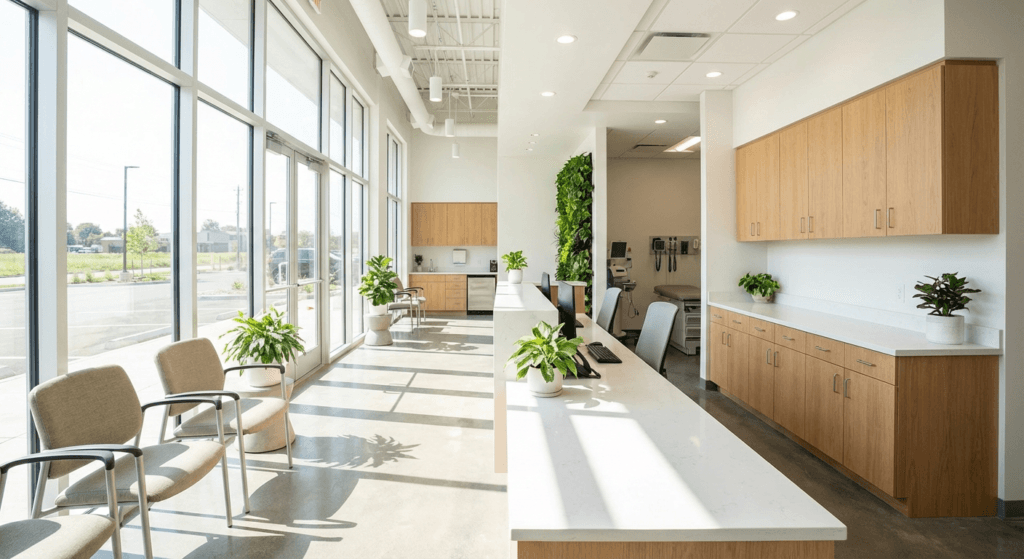
The biggest reason to choose low VOC cabinet paint for a commercial project is the health of the people inside the building. Employees, patients, students, and customers all breathe the same air. When that air is loaded with chemical fumes from conventional finishes, everyone is affected.
Fewer headaches and respiratory complaints
VOCs irritate the eyes, nose, and throat. In offices and clinics, employees who work near newly finished cabinets often report headaches, dizziness, and difficulty concentrating. Low-VOC finishes reduce these complaints because there are far fewer chemical fumes in the air.
Better air quality in sensitive environments
Some commercial spaces have higher stakes than others. Medical clinics and dental offices need clean air for patient safety. Schools and daycares house children who are more vulnerable to chemical exposure than adults. In these settings, low-VOC finishes are not a luxury. They are a basic requirement for responsible design.
Reduced chemical sensitivity reactions
A growing number of people experience chemical sensitivities that make conventional finishes unbearable. Strong paint fumes can trigger migraines, asthma attacks, and allergic reactions in sensitive individuals. Low-VOC products make your space accessible to more people, which matters in any public-facing commercial environment.
Faster return to normal operations
Traditional cabinet finishes can off-gas for weeks. That means an unpleasant smell and poor air quality long after the installation crew has left. Low-VOC and zero-VOC products cure in 24 to 48 hours with minimal odour, so your staff and customers can get back to normal faster.
Environmental benefits of choosing low VOC cabinet paint
The health benefits are reason enough to switch, but the environmental side matters too. VOCs do not just affect the people inside your building. They contribute to outdoor air pollution as well.
Less smog and ground-level ozone
When VOCs evaporate into the atmosphere, they react with nitrogen oxides in sunlight to form ground-level ozone, a key ingredient in smog. By choosing low-VOC finishes, you are reducing the amount of these chemicals released into the air during and after application.
Easier cleanup, less waste
Solvent-based finishes require chemical thinners and solvents for cleanup. Those chemicals create hazardous waste that needs proper disposal. Water-based low-VOC products clean up with soap and water, which means less contamination of groundwater and less hazardous waste heading to the landfill.
Supports green building standards
If your commercial project needs LEED certification or another green building standard, using low-VOC finishes helps you earn credits in the indoor environmental quality category. Many green building programs specifically require low-VOC paints and coatings as part of their certification criteria. Our sustainable millwork options can help you meet those requirements across your entire project.

Types of low-VOC finishes for commercial cabinets
Not all low-VOC finishes are the same. The right choice depends on where the cabinets will be used, how much wear they will see, and what look you want.
Water-based acrylic paint
This is the most common low VOC cabinet paint used in commercial work. Modern water-based acrylics have improved dramatically over the past decade. They offer good coverage, dry quickly, and resist yellowing over time. They work well on MDF, plywood, and solid wood substrates.
Water-based acrylics are a strong fit for corporate offices, retail spaces, and reception areas where appearance matters but heavy-duty chemical resistance is less of a concern.
Water-based polyurethane
For cabinets that need a harder, more durable clear coat, water-based polyurethane is a good step up. It provides better scratch and chemical resistance than acrylic paint while still keeping VOC levels low. This is a good choice for restaurant and hospitality millwork where surfaces get wiped down with cleaning products multiple times a day.
UV-cured finishes
UV-cured finishes use ultraviolet light to harden the coating almost instantly. They produce very low VOC emissions and create an extremely hard, durable surface. The tradeoff is that UV curing requires specialized equipment, so it is typically done in a shop setting rather than on-site. Our CNC manufacturing facility applies finishes in controlled conditions for the best possible result.
Low-VOC lacquers
Traditional lacquers are among the highest-VOC finishes available. But newer formulations using water-based or compliant solvent blends have brought VOC levels down significantly. Low-VOC lacquers can deliver that smooth, high-gloss look that some commercial designs call for, without the heavy chemical load.
What to look for when choosing low-VOC finishes
The label “low VOC” is not enough on its own. Here are the things that actually matter when evaluating a finish for your commercial cabinet project.
Check the grams per litre
Look at the actual VOC content listed on the product technical data sheet. For low VOC cabinet paint, look for products under 50 g/L for flat finishes and under 100 g/L for higher sheens. The lower the number, the fewer chemicals released into your space.
Ask about tinting
Here is something most people miss: the VOC number on the can usually refers to the base colour before tinting. The pigments and tints added to create your final colour can add VOCs that are not reflected on the label. Ask your finish supplier whether the tinting system is also low-VOC. Darker colours tend to require more tint, which can push VOC levels higher.
Consider the full system
A low-VOC topcoat applied over a high-VOC primer or sealer defeats the purpose. Make sure the entire finishing system, including primer, sealer, topcoat, and adhesive, is low-VOC. Your millwork supplier should be able to spec the full system for you.

Will low-VOC finishes hold up in commercial environments?
This is the most common concern we hear. Business owners worry that low-VOC finishes will not be as tough as traditional products. Ten years ago, that concern had some merit. Today, it does not.
Modern water-based and UV-cured low-VOC finishes perform on par with conventional solvent-based products in most commercial applications. They resist scratching, staining, and chemical damage at levels that meet the demands of healthcare facilities, restaurants, and high-traffic retail spaces.
There are a few honest limitations worth noting. Water-based finishes may need three to four coats where a solvent-based product only needs two. They can also be more sensitive to temperature and humidity during application, which is why shop-applied finishes tend to perform better than field-applied ones. And in extreme chemical exposure environments, such as industrial labs, solvent-based options may still have an edge.
For the vast majority of commercial cabinet projects in Saskatchewan, low VOC cabinet paint performs just as well as the conventional alternatives. The technology has caught up.
How Broadway Millwork handles low-VOC finishing
We apply finishes in our Saskatoon manufacturing facility under controlled temperature and humidity conditions. This matters for low-VOC products because proper application conditions make a real difference in the final result.
Shop-applied finishes cure more evenly and consistently than field-applied coatings. They also mean less odour and less disruption at your job site during cabinet installation. By the time your cabinets arrive, the finish is fully cured and ready for use.
We work with each client to match the right finish to their specific project requirements. A dental clinic has different needs than a retail store, and a school has different needs than a corporate boardroom. Our project process includes finish selection as part of the design phase, so there are no surprises down the line.
Low-VOC finishes and your budget
Low-VOC products do cost more per litre than conventional finishes. Depending on the product, you might pay 10 to 20 percent more for the materials. But the total cost picture is more balanced than that number suggests.
Water-based products clean up with soap and water instead of expensive chemical solvents. They cure faster, which can reduce labour time on finishing. And the reduced off-gassing means less ventilation equipment and downtime needed during and after installation.
For healthcare and education projects where indoor air quality standards are strict, low-VOC finishes may be required anyway. In those cases, it is not a question of if you should use them, but which specific products to choose.
Frequently asked questions about low-VOC cabinet finishes
Are low-VOC cabinet finishes as durable as traditional ones?
Yes, in most commercial applications. Modern water-based and UV-cured low VOC cabinet paint products match the performance of solvent-based finishes for scratch resistance, chemical resistance, and longevity. They may need an extra coat, but the end result holds up to daily commercial use.
How long does the smell last with low-VOC finishes?
Most low-VOC finishes are nearly odour-free within 24 to 48 hours after application. Compare that to traditional solvent-based products, which can off-gas for several weeks. If your cabinets are finished in a shop before delivery, there will be little to no smell when they are installed on site.
Do low-VOC finishes come in the same colours?
Yes. Low-VOC paints and finishes are available in the full range of colours and sheens. Just remember to ask about low-VOC tinting systems, since standard tints can add VOCs to an otherwise clean base product.
Can I use low-VOC finishes on any cabinet material?
Low-VOC paints and clear coats work well on plywood, MDF, and solid wood. The key is proper surface preparation and using the right primer for the substrate. Your millwork supplier should recommend a complete finishing system that works with your chosen material.
Choose a healthier finish for your next project
Low-VOC cabinet finishes protect the health of the people in your building, reduce your environmental footprint, and perform just as well as conventional products in commercial settings. The technology has matured, the costs have come down, and the benefits are clear.
If you are planning a commercial cabinet or custom millwork project in Saskatoon or anywhere in Saskatchewan, we can help you choose the right materials and finishes for your space. Request your free quote or call (306) 975-2020 to get started.
Request a Quote
Service Areas
We serve businesses across Saskatchewan, from Saskatoon and Regina to smaller regional centres throughout the province. Here are some of the communities where we regularly complete commercial millwork projects:
- Saskatoon
- Regina
- Prince Albert
- Moose Jaw
- Swift Current
- Yorkton
- North Battleford
- Lloydminster
- Estevan
- Weyburn
- Martensville
- Warman
- Humboldt
- Meadow Lake
Don’t see your community on the list? We take on projects across Saskatchewan and into neighbouring provinces, including Alberta and Manitoba. Contact us to discuss your project location and we’ll let you know how we can help.