
How to Read a Millwork Quote: A Guide for Business Owners
You asked for a quote on custom millwork for your business. A few days later, a multi-page document shows up in your inbox. It has line items, material codes, labour charges, and terms you have never seen before. If you are not sure what you are looking at, you are not alone. Most business owners have never had to learn how to read a millwork quote, and the first one can feel like it is written in another language.
This guide breaks it down section by section so you can compare quotes, catch hidden costs, and feel confident before you sign anything.
Why Millwork Quotes Look Different from Other Estimates
A millwork quote is not like getting a price on office furniture or a paint job. Every piece is custom built, which means the quote needs to account for design, materials, fabrication, finishing, and installation. That is a lot of moving parts.
Unlike a retail price tag, a commercial millwork quote is really a small project plan. It tells you what will be built, what it will be made from, how it will be finished, and how it will get into your space. Some quotes do a better job of explaining all this than others, which is exactly why you need to know what to look for.
The Header: Project Details and Scope
The top of most millwork quotes includes your business name, the project location, a quote number, and a date. Check these carefully. An expired quote may have outdated material pricing, especially if lumber or laminate costs have shifted since it was issued.
You should also see a brief project description or scope of work. This is the summary of what the millwork company plans to build. Read it closely. Does it match what you discussed during your consultation? If you asked for a reception desk and three storage cabinets but the scope only mentions the desk, that is a problem to flag right away.
Line Items: Where the Real Numbers Live
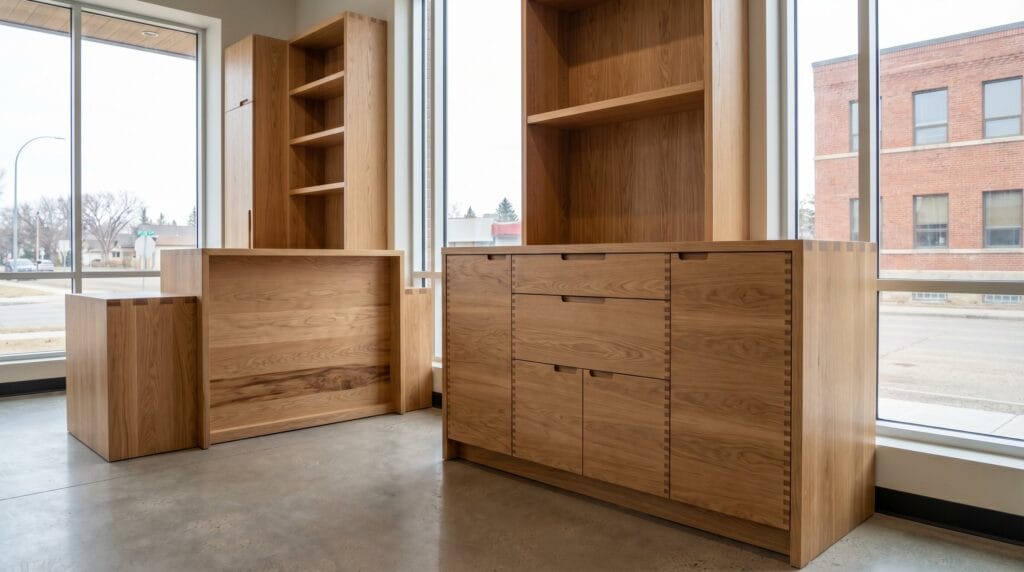
The body of a millwork quote is usually a list of line items. Each one describes a specific piece or group of pieces. For example, you might see separate line items for upper cabinets, lower cabinets, a countertop, and a reception desk.
Here is what to look for in each line item:
Description. This should tell you what is being built. Good descriptions include dimensions, the number of units, and basic construction details. “Custom upper cabinets, 36″W x 30″H x 12″D, qty 4” is useful. “Upper cabinets” by itself is not.
Materials. The quote should name the specific materials. There is a big price difference between commercial-grade plywood and melamine, and an even bigger gap if solid wood or veneer is involved. If the quote just says “wood” or “standard materials,” ask for more detail.
Finish. This covers the surface treatment. Will the cabinets be painted, stained, or wrapped in thermofused laminate? Each finish has a different cost and a different level of durability. A healthcare project using low-VOC finishes will cost more than a standard paint job, but it may be required for your facility.
Unit price and total. Some quotes show a per-unit price, others show a lump sum per line item. Either way, you should be able to trace how the total was calculated.
Labour, Installation, and Delivery
Materials are only part of the cost. The rest comes from the people who build and install everything.
Some millwork companies include labour in each line item. Others break it out separately. Neither approach is wrong, but you need to know which format you are looking at so you can compare quotes fairly. If Company A bundles labour into the line items and Company B lists it separately at the bottom, the two quotes will look very different even if the total price is close.
Professional installation is often listed as its own line item. This typically covers delivery to your site, placement, levelling, fastening, and final adjustments. Ask whether installation includes things like cutting around existing plumbing or electrical, because that kind of site work can add cost if it is not already in the quote.
Delivery charges may also appear as a separate line, especially if your project is outside the millwork company’s home city. For businesses in Regina, Prince Albert, or other Saskatchewan communities, delivery fees can vary based on distance.
What a Millwork Quote Should Include (and What to Watch For)
| Section | What It Should Say | Red Flag If Missing |
|---|---|---|
| Scope of work | Clear description of every item being built | Vague or incomplete descriptions |
| Materials | Specific material types and grades | “Standard materials” with no detail |
| Finishes | Paint colour, stain type, or laminate brand and code | No finish specified |
| Hardware | Hinges, pulls, drawer slides named by brand or grade | No hardware mentioned at all |
| Installation | What is included (delivery, levelling, fastening) | Installation listed as “TBD” or not included |
| Timeline | Estimated start date and completion date | No timeline or lead time mentioned |
| Payment terms | Deposit amount, progress payments, final payment | Full payment required upfront |
| Warranty | Length and what it covers | No warranty information |
Hardware: The Small Details That Add Up
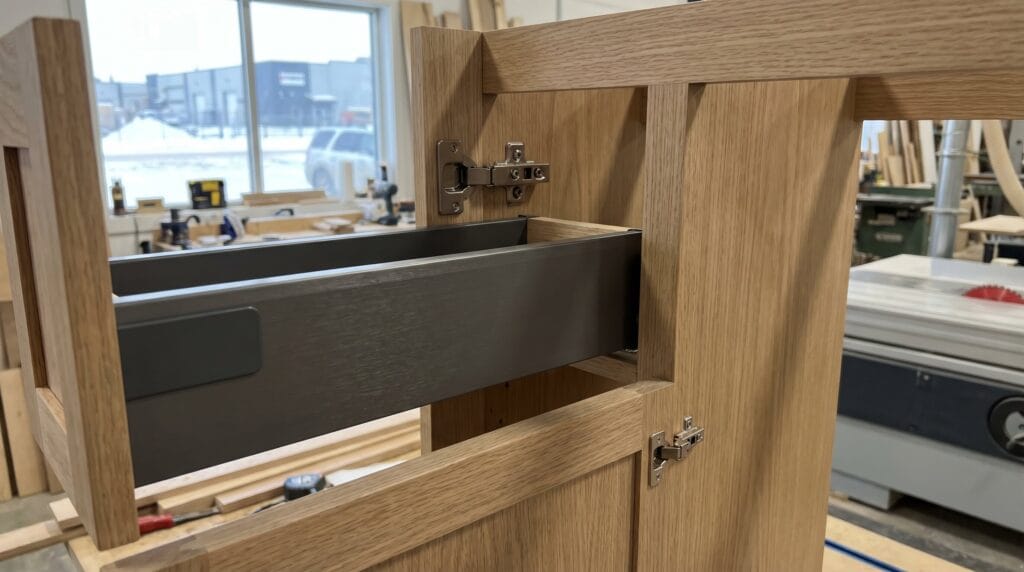
Drawer slides, hinges, pulls, and locks are easy to overlook on a millwork quote. But hardware has a huge impact on how your commercial cabinets feel and how long they last.
Soft-close hinges cost more than standard ones. Full-extension drawer slides cost more than three-quarter extension. Commercial-grade pulls that can handle thousands of daily touches cost more than residential hardware that looks similar but wears out faster. If the quote does not name the hardware, you have no way of knowing what you are getting.
Countertops: A Common Add-On with Its Own Pricing
If your project includes commercial countertops, these usually appear as a separate line item or even a separate section. Countertop pricing depends on the material, the edge profile, and any cutouts for sinks or equipment.
Laminate countertops are the most affordable option for most commercial spaces. Solid surface and quartz cost more but offer seamless joints and better repairability. The quote should specify which material is being used, because swapping from laminate to quartz can double the countertop cost on some projects.
Terms, Conditions, and the Fine Print
Scroll past the numbers and you will find the terms and conditions. This section covers payment schedules, change order policies, warranty details, and expiry dates.
Most commercial millwork projects use a deposit-and-progress structure. You pay a deposit when you approve the quote, another payment when materials are ordered or fabrication begins, and the final balance on completion. A 50/50 split (half upfront, half on delivery) is common for smaller projects. Larger jobs might use a 40/30/30 structure.
Pay attention to the change order clause. Once fabrication starts, changes to dimensions, materials, or finishes will almost always cost extra. The quote should explain how changes are handled and what approval process is required. This matters more than most people realize, because mid-project changes are the number one reason commercial millwork projects go over budget.
Comparing Quotes from Different Companies
When you have two or three quotes in front of you, it is tempting to skip straight to the bottom line. But the lowest total price does not always mean the best value.
Here is a simple way to compare. Line up the quotes side by side and check whether each one covers the same scope. Are the materials the same grade? Is CNC manufacturing included, or is the work being done by hand? Does one quote include installation while the other does not? Are the hardware specs comparable?
A quote that is $5,000 cheaper but uses melamine instead of plywood, skips soft-close hardware, and does not include installation is not actually cheaper. It is just incomplete.
If two quotes have a large price gap and the scope looks similar, call each company and ask them to walk you through the differences. A good millwork company will be happy to explain exactly what you are paying for.
Questions to Ask Before You Approve a Quote
Before you sign off on a millwork quote, run through these questions:
Does the scope match what I asked for? Go back to your original project notes and make sure nothing was missed or added without your input.
Are the materials clearly named? You should know whether you are getting plywood, MDF, melamine, or solid wood for every component. If you need help understanding the differences, our guide to choosing commercial cabinet materials covers the basics.
Is the timeline realistic for my business? A typical commercial millwork project takes 6 to 12 weeks from approval to installation. If you have a hard deadline, like a store opening or a lease start date, make sure the quoted timeline accounts for it.
What happens if something goes wrong? Look for warranty details and ask about their process for handling defects or damage during installation.
How long is this quote valid? Material prices change. Most quotes are good for 30 to 60 days. If you wait too long, the price may need to be updated.
Industry-Specific Things to Watch For
Depending on your business type, your millwork quote may need to address specific requirements.
Healthcare and dental clinics need materials that can be cleaned with hospital-grade disinfectants. The quote should specify antimicrobial or chemical-resistant surfaces.
Restaurants and food service businesses need food-safe materials and moisture-resistant construction. If your quote does not mention water resistance or food contact compliance, ask about it.
Retail stores often need lighting integrated into display cabinets. Check whether electrical rough-in or LED installation is included in the quote or if that is a separate trade.
Schools and educational facilities may require impact-resistant edges and tamper-proof hardware. These add cost but are often required by the building code or the school board.
Getting a Quote You Can Trust
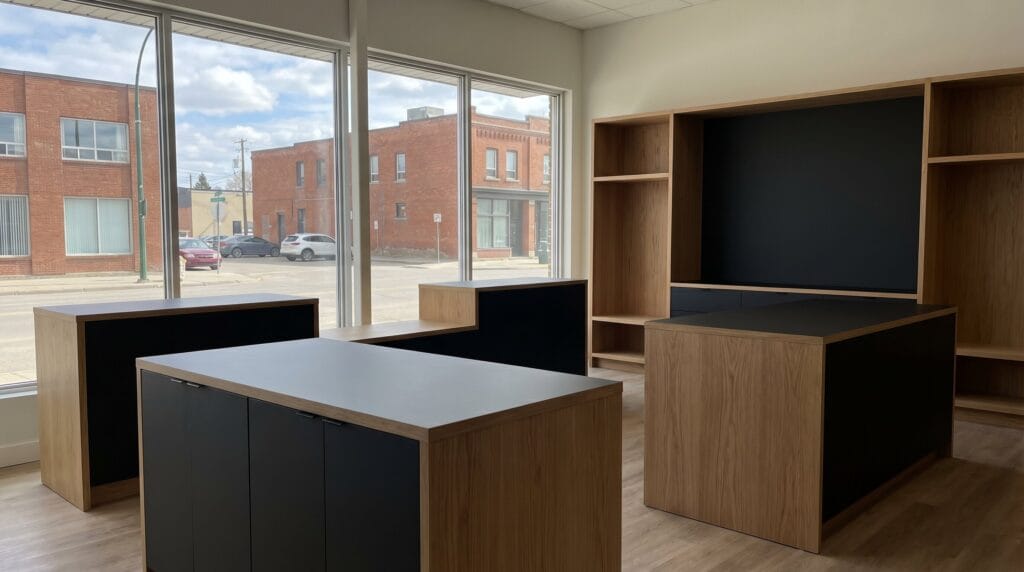
A detailed, transparent quote is one of the best signs that a millwork company knows what they are doing. Vague quotes lead to surprises. Clear quotes lead to projects that stay on budget and on schedule.
If you are planning a commercial project in Saskatoon or anywhere in Saskatchewan, request a free quote from Broadway Millwork. We have been building custom cabinets, countertops, and millwork for Saskatchewan businesses since 1995, and we are happy to walk you through every line of your estimate.
Call us at 639-638-2002 or email sales@broadwaymc.ca to get started.
Frequently Asked Questions
What should be included in a commercial millwork quote?
A good commercial millwork quote should include a scope of work, material specifications, finish details, hardware, installation, delivery, a timeline, payment terms, and warranty information. If any of these sections are missing or vague, ask the company to fill in the gaps before you approve anything.
How do I compare millwork quotes from different companies?
Line up the quotes side by side and check that each one covers the same scope, materials, hardware, and services. A lower price does not always mean better value. One quote might exclude installation, use lower-grade materials, or skip soft-close hardware. Compare what is included, not just the total at the bottom.
How long is a millwork quote usually valid?
Most millwork quotes are valid for 30 to 60 days. After that, material prices may have changed and the company may need to update the estimate. If you know you will need more time to make a decision, let the company know upfront so they can advise you on timing.
Why do millwork quotes vary so much between companies?
Differences in material grades, hardware quality, manufacturing methods, finish options, and whether installation is included can all cause price gaps. A company using CNC manufacturing and commercial-grade plywood will price differently than one using manual fabrication and melamine. The details in the quote tell you why the numbers are different.
Can I negotiate a millwork quote?
You can always ask questions and discuss options. If the total is above your budget, a good millwork company can suggest alternatives, like swapping a solid surface countertop for laminate, or using a different finish to bring the price down. The goal is to find the right balance between quality and cost for your specific project.
Request a Quote
Service Areas
We serve businesses across Saskatchewan, from Saskatoon and Regina to smaller regional centres throughout the province. Here are some of the communities where we regularly complete commercial millwork projects:
- Saskatoon
- Regina
- Prince Albert
- Moose Jaw
- Swift Current
- Yorkton
- North Battleford
- Lloydminster
- Estevan
- Weyburn
- Martensville
- Warman
- Humboldt
- Meadow Lake
Don’t see your community on the list? We take on projects across Saskatchewan and into neighbouring provinces, including Alberta and Manitoba. Contact us to discuss your project location and we’ll let you know how we can help.